

Crossing Disciplinary Boundaries for National Security
What works, what doesn’t

Contemporary national security challenges require complex responses that integrate knowledge across disciplinary, institutional, and methodological boundaries. Yet while interdisciplinarity is widely endorsed as necessary for addressing complex threats, systematic evidence on how it operates and what practices make it effective remains fragmented.
This review synthesizes findings from five studies examining how multiple disciplinary inputs and related cross-disciplinary analysis contribute to improving analytic outcomes for security gains. Evidence indicates that boundary-crossing approaches improve analytic transparency, conceptual coherence, and collaborative capacity, though causal links to downstream security outcomes remain under-evaluated. The review concludes by outlining a framework based on existing studies from which future agendas can build.
This post is part of Bridging Boundaries, a living literature review on interdisciplinarity.

Image credit: The League of European Research Universities (LERU)
**
National security institutions increasingly confront problems whose causes, dynamics, and consequences span multiple domains of expertise. Enhancing cyber security requires expertise related to technical architecture, behavioral vulnerabilities, and organizational processes. Disinformation campaigns involve political psychology, network science, platform design, and geopolitical strategy. Climate-related instability intersects environmental science, economics, social context, and conflict analysis. Most contemporary security threats are not merely complicated but fundamentally interdisciplinary.
In nuclear security, Sagan (1993) highlighted the important reality that organizations with stronger internal technical expertise are better at identifying failure pathways and preventing accidents. In conflict prevention and response, ensuring right technical experts are brought together to avoid the greatest national security harms remains a security imperative.
Despite this reality, national security organizations have historically been organized along disciplinary and bureaucratic lines. Analysts specialize; agencies compartmentalize; research programs divide expertise into technical or social domains. As a result, collaboration across boundaries is often ad hoc rather than institutionalized. Understanding how interdisciplinary collaboration works, and what concrete benefits it produces, has therefore become an urgent issue.
The Case for Interdisciplinarity in Security
The National Academies of Sciences (2019) finds that social and behavioral science research has substantial potential to improve analytic tradecraft, yet its integration into intelligence institutions has historically been inconsistent and unsystematic. This gap reflects institutional and structural barriers rather than lack of relevant knowledge. The report therefore frames interdisciplinarity not as an aspirational ideal but as an operational requirement for effective intelligence analysis.
The report also highlights the need for interdisciplinary design of analytic tools. Technologies such as artificial intelligence, advanced visualization systems, and distributed analytic platforms depend on insights from psychology, cognition, and organizational science to ensure that human analysts can interpret outputs correctly and collaborate effectively. Interdisciplinarity thus operates at both analytic and technological levels.
The strongest empirical evidence in the literature related to interdisciplinarity and national security concerns intermediate outcomes rather than direct causal links to national security performance.
· First, interdisciplinary engagement can improve conceptual coherence. Cains et al (2022) demonstrates that structured cross-disciplinary dialogue can identify definitional inconsistencies and produce shared frameworks, enabling more consistent analysis and coordination.
· Second, structured analytic methods can improve transparency and evaluability. Artner et al (2017) show that analytic processes often lack documentation, making it difficult to assess reasoning quality. Interdisciplinary teams using structured methods are better positioned to produce auditable analyses and learn from past judgments.
· Third, interdisciplinary integration can enhance analytic ecosystems. National Academies of Sciences (2019) finds that combining insights from social science and technical disciplines can improve the design of analytic tools, forecasting systems, and human–machine collaboration architectures. These improvements can strengthen analytic performance at
Conceptual Barriers: Language, Definitions, and Epistemic Misalignment
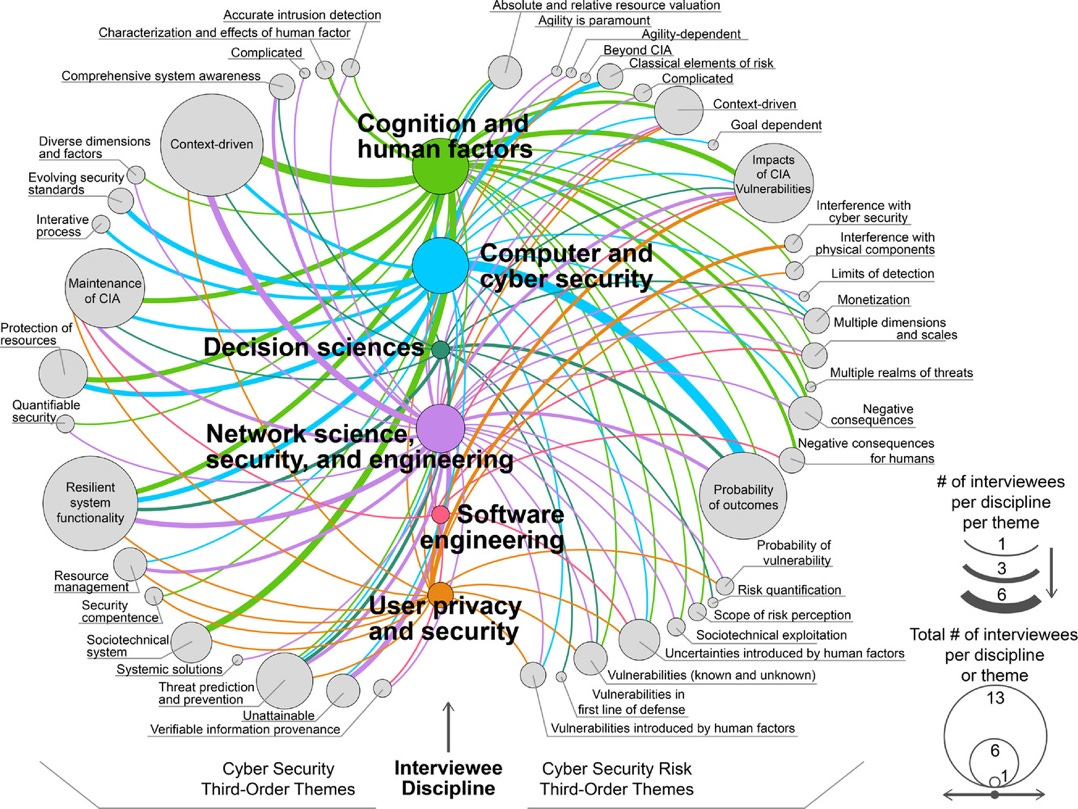
Cains et al (2022)’s study of cyber-security researchers and practitioners working within a U.S. Army–funded collaborative research alliance uses semi-structured interviews with twenty-seven participants across academia and government to examine how experts defined key concepts such as “cyber security” and “cyber security risk.”
Drawing on thematic coding, network analysis, and comparative content analysis, the study showed significant variation in definitions across participants. Network density—a measure of conceptual connectedness—was substantially higher for “cyber security” (0.795) than for “cyber security risk” (0.317), indicating far less agreement about the meaning of risk than security itself. The authors also found that vocabulary used by developers often did not match terminology used by practitioners.
These findings provide some quantitative evidence of interdisciplinary divergence in national security. They also demonstrate that disagreement often occurs not at the level of conclusions but at the level of underlying concepts. In operational contexts, such misalignment can translate into inconsistent threat prioritization, incompatible analytic outputs, or flawed decision support.
The study suggests that early-stage conceptual alignment, through shared glossaries, structured elicitation, or conceptual mapping, is a necessary precursor to effective interdisciplinary intelligence analysis.
Structured Analytic Methods as Integrative Tools
With conceptual divergence a central challenge, a potential solution is structured analytic methods. Artner et al (2017) evaluate analytic methods designed to improve reasoning transparency, reduce cognitive bias, and enhance analytic rigor.
Despite widespread use of structured analytic methods across intelligence agencies, the community has rarely assessed whether they improve analytic quality. The research team conducted a pilot review of twenty-nine intelligence assessments posted internally over a two-week period, developing an evaluation framework capable of assessing analytic transparency, documentation of assumptions, and use of structured reasoning.
One key observation was that many analytic products referenced alternative scenarios or hypotheses without documenting how those alternatives were generated, under what assumptions or frameworks and drawing on which cognitive or disciplinary bases. Without such documentation, reviewers cannot determine whether analytic reasoning was systematic or intuitive, nor whether diverse domain expertise informed the analysis.
The study suggests how structured analytic techniques can serve two interdisciplinary functions: they enhance analytic rigor by externalizing reasoning processes, and they also create shared procedural frameworks that allow experts from different disciplines to integrate knowledge in transparent and auditable ways. In effect, structured methods can facilitate collaboration among specialists with distinct epistemologies.
Institutional Infrastructure for Boundary Crossing
Alongside well-designed analytic tools is a broader need to address structural barriers for interdisciplinary input into national security. Several studies emphasize that interdisciplinary collaboration depends on institutional environments intentionally designed to support boundary crossing.
Vogel and Tyler (2019) analyze five historical and contemporary U.S. Intelligence Community initiatives to identify what organizational designs make interdisciplinary, cross-sector collaboration effective for intelligence work. They find such collaborations are difficult to establish and sustain, typically depend on high-level champions, stable funding, and clear mission relevance, and often fail when leadership or budget priorities shift., and alignment between long-term research goals and short-term operational needs.
A policy report by Shapiro et al (2020) and colleagues analyzing defense research models highlights organizations that bridge academia, government, and industry. These collaborative structures must balance openness with security: they must maintain credibility with external researchers while protecting sensitive information and enabling cross-platform analysis.
The report identifies hybrid institutions—such as the Laboratory for Analytic Sciences (LAS)—as particularly effective. LAS enables sustained collaboration among academic researchers, industry experts, and intelligence personnel working on sensitive analytic problems. Government participants often serve multi-year rotations at the lab, allowing time for trust building and shared understanding. The lab also established a dedicated collaboration team tasked with facilitating communication, translating terminology, and coordinating research across participants.
Supporting evidence from research summaries on intelligence-community collaborations identifies recurring success factors, including leadership support, long-term commitment, communication mechanisms for assessing progress, and clear lines of communication with operational stakeholders. These factors underscore that interdisciplinarity is not merely a matter of assembling diverse expertise but of designing institutions that make collaboration durable.
Incentives, Career Structures, and Time Horizons
Incentives play a decisive role in determining whether interdisciplinary collaboration occurs and whether it persists long enough to produce meaningful results. Shapiro et al (2020) emphasizes that effective collaborative organizations address incentives across the entire research lifecycle: project design, resource allocation, data access, and publication. Without such alignment, participants may prioritize disciplinary outputs or organizational mandates over collaborative goals.
The National Academies of Sciences (2019) survey similarly notes that integration of social and behavioral science into intelligence analysis has often been inconsistent because institutional structures do not systematically reward such integration. Analysts and researchers operate under performance metrics that may favor speed, specialization, or short-term deliverables rather than synthesis.
Time horizon is closely related. Interdisciplinary teams typically require extended periods to learn each other’s assumptions, methods, and terminology. Short funding cycles or temporary assignments can prevent teams from reaching the stage at which integration yields analytic benefits. Long-term institutional commitment therefore emerges as a critical enabling condition.
Trust, Communication, and Cultural Translation
Trust is frequently discussed as a soft variable, but in national security contexts it has concrete operational implications. Collaboration often occurs under conditions of secrecy, classification, and bureaucratic compartmentalization. These constraints can inhibit information sharing and discourage open discussion.
Evidence from studies of intelligence-community collaborations indicates that successful interdisciplinary initiatives cultivate explicit norms encouraging participants to acknowledge uncertainty, ask clarifying questions, and share incomplete ideas. They also establish clear rules governing data access and communication so participants understand what can be shared and how.
Translation roles are particularly important. Individuals or teams responsible for bridging disciplinary and institutional cultures help maintain alignment and prevent misunderstandings. In the LAS model, a dedicated collaboration team performs this function, illustrating that translation is not incidental but an institutionalized responsibility.
AMulti-Level Framework for Interdisciplinary Input for Security
Synthesizing across the studies reviewed, interdisciplinary national security collaboration can be conceptualized as a layered system:
Individual level: communication skills, openness to uncertainty, familiarity with structured methods.
Team level: shared definitions, documented reasoning, agreed analytic procedures.
Organizational level: boundary-spanning institutions, aligned incentives, secure data environments.
System level: integration of human and machine analysis, evaluation mechanisms, long-term research agendas.
Alignment across these levels creates reinforcing effects that enhance analytic capability. Misalignment at any level can undermine collaboration even when other components function well.
Conclusion
The literature reviewed supports a conclusion that interdisciplinary collaboration is not merely beneficial but essential for contemporary national security analysis. Complex threats require analytic approaches capable of integrating diverse forms of expertise and data. Empirical studies demonstrate that interdisciplinary practices can improve conceptual clarity, analytic transparency, and collaborative effectiveness—core elements of sound security decision-making.
However, interdisciplinarity does not emerge automatically. It must be deliberately designed through institutional structures, analytic tools, incentive systems, and trust-building practices. National security organizations that invest in these enabling conditions are more likely to develop the analytic capacity required to understand and respond to complex threats.
Still significant research gaps remain. The field lacks systematic evaluations linking interdisciplinary methods to downstream security outcomes. Addressing this gap will require new measurement strategies, longitudinal studies, and institutional experimentation, efforts still central to the future effectiveness of national security institutions.
References
Artner, Stephen, Richard S. Girven, and James B. Bruce. 2017. Assessing the Value of Structured Analytic Techniques in the U.S. Intelligence Community. Santa Monica, CA: RAND Corporation.
Cains, M. G., et al. 2022. “Defining Cyber Security and Cyber Security Risk within a Multidisciplinary Context Using Expert Elicitation.” Journal of Cybersecurity.
National Academies of Sciences, Engineering, and Medicine. 2019. A Decadal Survey of the Social and Behavioral Sciences: A Research Agenda for Advancing Intelligence Analysis. Washington, DC: National Academies Press.
Shapiro, Jacob N., et al. 2020. Collaborative Models for Understanding Influence Operations: Lessons from Defense Research. Washington, DC: Carnegie Endowment for International Peace.
Vogel, Kathleen M., and Beverly B. Tyler. 2019. “Interdisciplinary, Cross-Sector Collaboration in the U.S. Intelligence Community: Lessons Learned from Past and Present Efforts.” Intelligence and National Security.