

The Interdisciplinary Gender Gap
Are women more interdisciplinary than men?

Despite growing calls for interdisciplinary research, scholars, funders, and policymakers continue to report hurdles to delivering interdisciplinary research in practice. Structures that prioritize disciplinary specificity in publishing, promotions and funding have continued to challenge efforts to expand interdisciplinary research, a topic of this Living Literature Review.
But research indicates that, despite shared challenges across research fields, some researchers are more likely to conduct interdisciplinary research than others. Within these studies is indication from a small but growing number of studies that find more senior women can be more likely to cross disciplines in their research than men. This is the subject of this post.
While there is some indication that women tend to conduct more interdisciplinary research than men, more research is needed into the motivations, norms, structures, and processes that underlie these gender differences.
More women, more disciplinary collaboration?
Large scale survey analysis from Rhoten and Pfirman (2007) and biliometric analysis from Science-Metrix (2019) find that women may exhibit a stronger preference for interdisciplinary research than men. Science-Metrix found among Canada’s NSERC awardees that female researchers exhibited higher rates of highly interdisciplinary papers (those in the top 10%) than male researchers (11% vs. 9.2%). Rhoten and Pfirman find women particularly express preference towards team collaboration and problem orientation.
Araújo et al (2017) similarly found in a study of more than 270,000 scientists in the natural sciences that women with many collaborators are more likely to have collaborators from other fields than their male peers. These effects differed, however, in other fields, showing that gender effects are not consistent across all areas.
What explains these differences remains subject for further research. Some suggest that women tend to be more collaborative in general, though men are more likely to collaborate with other men. Other studies suggest that norms or behaviors related to communication skills, social sensitivity, flexibility and social impact can drive women to be more collaborative in research and reaching across disciplines than men.
Pinhero et al (2022) posit that data may be impacted by a measurement bias due to the fact that women self-cite less than men (see Anderson et al 2019). Because interdisciplinarity is often measured by the diversity of cited references in publications, self-cites can can reduce the impression of interdisciplinarity. But when controlling for a potential self-citation bias, they still find that women are positively associated with interdisciplinarity in their study.
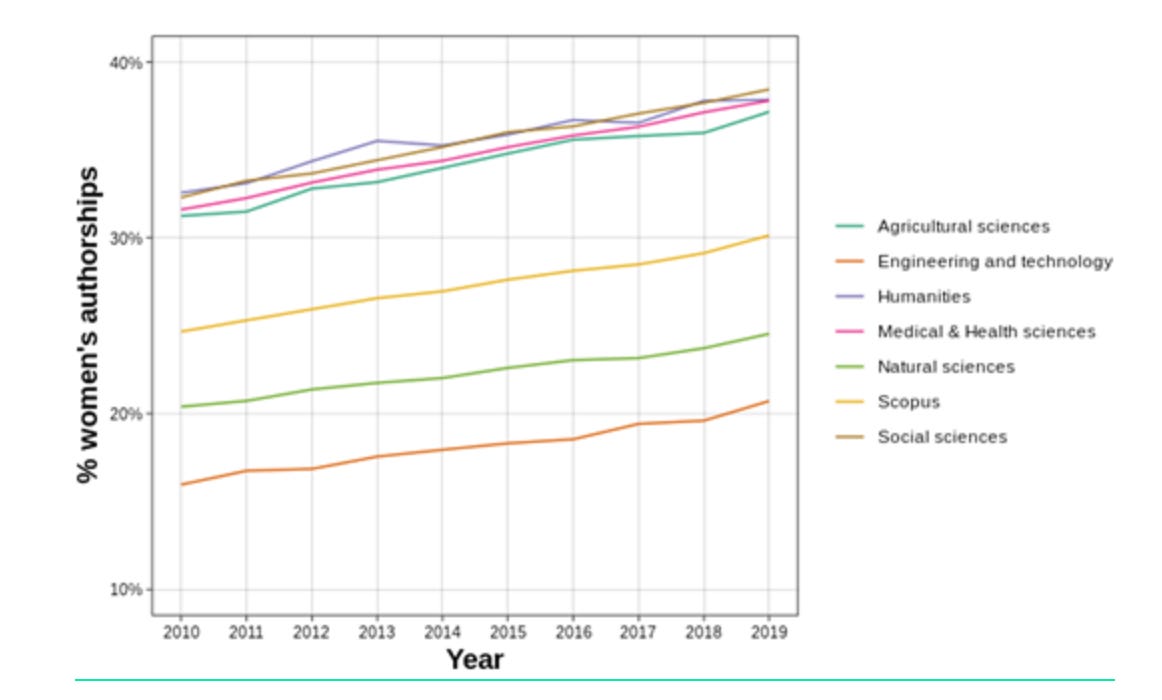
Source: Pinheiro et al 2022
But… Are Junior Women Researchers Doing Less Interdisciplinary Research?
And yet, further studies have suggested this affect can reduce or even reverse when disaggregating researchers by seniority in their fields. Liu et al (2023) found in a study of 675,135 doctoral theses from 1950 to 2016 in five scientific disciplines that male doctoral students were more likely to undertake interdisciplinary in their research than their female peers, perhaps reflecting greater flexibility and authority afforded to males than females. They found that these disparities have become more pronounced since 2000 and among top-tier (R1) universities, and that the presence of a female doctoral advisor can negatively impact the interdisciplinary nature of research.
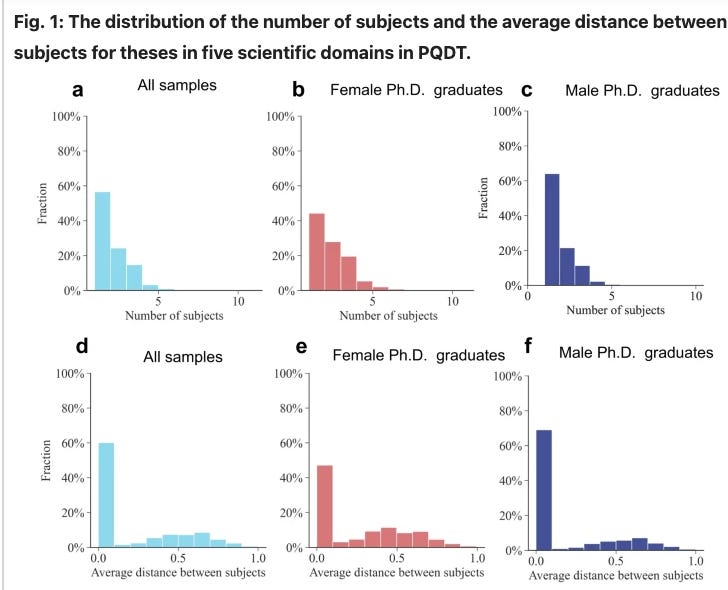
Source: Liu et al (2023)
Smith-Doerr and Croissant (2016) similarly find in an ethnographic study of chemical scientists that junior female scientists are sometimes discouraged from pursuing interdisciplinary research that is perceived as “riskier.” Their interviews uncovered that despite expectations that women may be well suited to interdisciplinarity based on perceptions about women as being more collaborative and interested in societal impact, the “gendered cultural expectation that does not match up to the reality of the costs and benefits in practice.”
Closing the gap?
Given indication that junior women researchers tend may face greater hurdles to interdisciplinary research than male peers, more research is needed into what drives these differences and potential solutions.
“If women, relative to men, are more likely to perceive interdisciplinary work as too high risk, and if funders do not take action to correct the potential consequences of such perceptions, the overall research ecosystem could be negatively impacted.” - Pinheiero et al
Smith-Doerr and Croissant describe a “catch 22” for women researchers, who simultaneously face norms urging them to collaborate alongside incentives to maintain disciplinary silos. They write,
“Women scientists encounter both expectations to collaborate, and, at the same time (through discouraging advice from mentors and peers), significant disincentives to do interdisciplinary and collaborative work.” - Smith-Doerr and Croissant
The interactions of the trends examined in these studies with wider gendered dynamics in academic and research spaces requires deeper scrutiny. Indication that women sometimes serve as productive bridge builders in interdisciplinary collaborations requires deeper analysis too. Without reinforcing gendered stereotypes, the implications of known attrition of female scientists as seniority advances in many fields merits scrutiny, if this could be linked to potential reductions in interdisciplinary collaborations, given the societal emphasis on interdisciplinary of innovation and research for societal good.
**
Check out more from the Bridging Boundaries, a Living Literature Review on Interdisciplinary Research here!